Skip to the transcript

I’m an award-winning, queer nutritionist – AMA!

r/IAmA · 22 Sep 2026, 15:01 UTC · posted by u/JKPBooks · 6 answers

Verbatim from the Arctic Shift archive of the Reddit thread, fetched 21 Oct 2026. Text is as the archive first saved it; comments may have been edited or deleted on Reddit since. View the thread on Reddit

Only the hosts’ replies and the comments they replied to; 14 other comments are left out. Times count from the post: +1h05m means 1 hour 5 minutes after it went up.

Listen

Download the MP3 (12 min, 4.5 MB)

Read aloud by synthetic voices (Kokoro). The host’s voice is theirs alone; everyone else’s is assigned at random. They are not the participants’ real voices. About the audio

Hosts

  • u/JKPBooks posted the AMA · flair “Verified” · 6 answers

Introduction

the introduction

Hi Reddit,

I’m Daniel O’Shaughnessy. I’m a nutritionist, a Functional Medicine Certified Practitioner and a former addiction counsellor with a Master’s degree focused on integrative approaches to mental health, and I’ve spent more than 15 years working with people around nutrition, behaviour, body image and health.

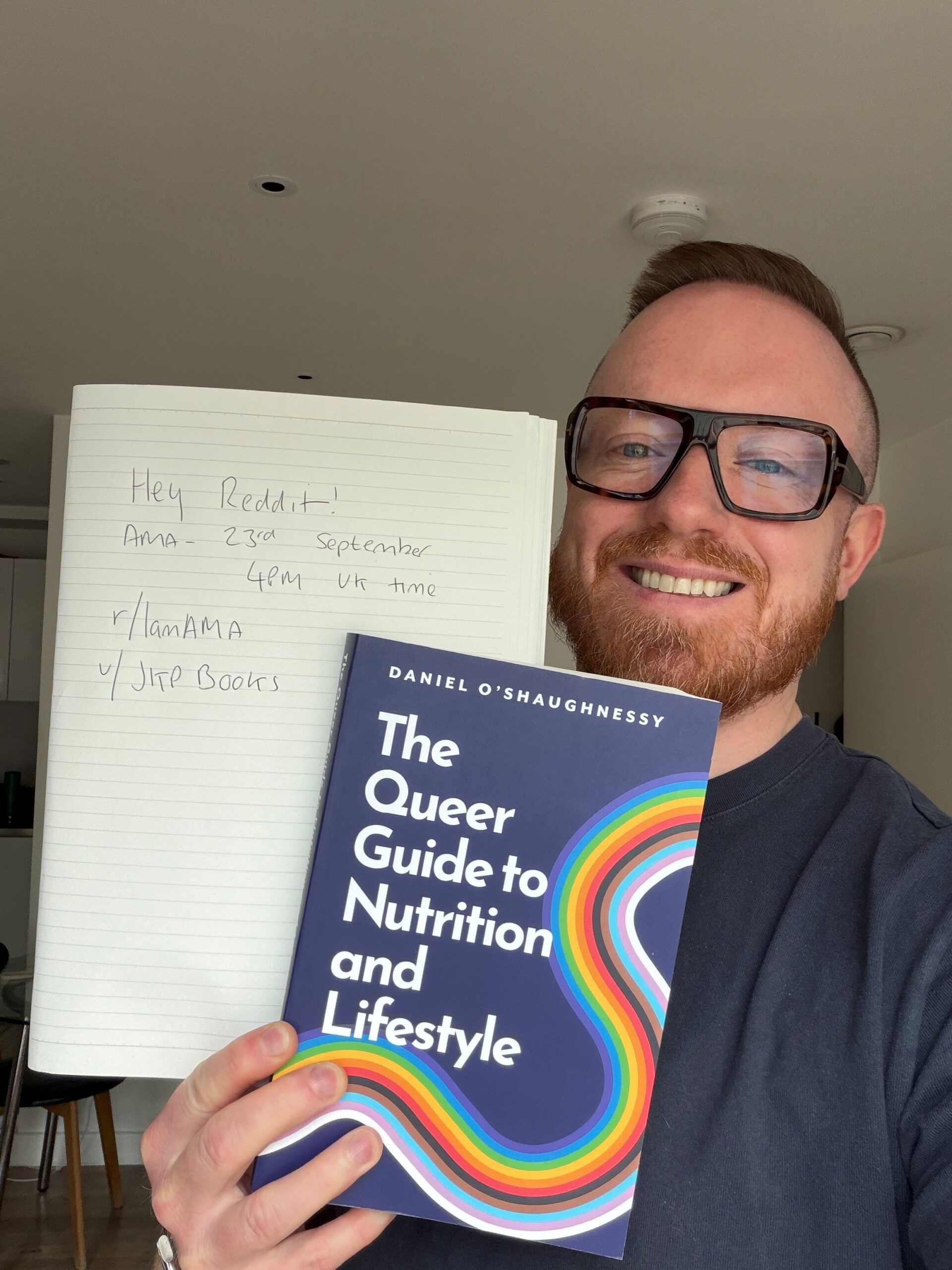
My new book, The Queer Guide to Nutrition and Lifestyle, grew out of something I kept seeing in practice: LGBTQ+ health is often reduced either to medical risk or to how our bodies look, while a lot of the ordinary, complicated reality of looking after ourselves gets missed.
The book looks at health through a queer lens, not because LGBTQ+ bodies require an entirely different set of nutritional rules, but because our health is shaped by much more than biology alone. Identity, body image, social and cultural pressures, relationships, access to healthcare, stigma and lived experience can all affect how we eat, exercise, sleep, have sex, look after ourselves and relate to our bodies.
It starts with the foundations, including nutrition, digestion, stress, sleep, skin and hair, before moving into some of the areas where queer experiences and mainstream health advice often collide: weight loss and muscle gain, body dysmorphia and performance enhancers, sex and pleasure, transgender and gender-affirming health, HIV and PrEP, the party lifestyle, mental health, and LGBTQ+ fertility and family building.
I’ve tried to approach the subjects people sometimes find difficult to talk about without judgement or assumptions and without pretending health happens neatly outside the rest of our lives.

So ask me anything about queer health, nutrition, body image, sex and wellbeing, trans health, the party lifestyle, HIV and PrEP, fertility and family building, mental health, the wellness industry, or writing the book.

You can find The Queer Guide to Nutrition and Lifestyle here: https://uk.jkp.com/products/the-queer-guide-to-nutrition-and-lifestyle

Ask me anything!

PROOF: https://blog.jkp.com/wp-content/uploads/2026/09/reddit-ama-scaled.jpg

1. What are some of the most positively impactful lifestyle changes you suggest for queer women especially and…

u/Muted_Leading795 ·

What are some of the most positively impactful lifestyle changes you suggest for queer women especially and why?

u/JKPBooks ·

I don’t think queer women need a completely separate lifestyle rulebook. The fundamentals are still the fundamentals: eating enough, eating regularly, getting plenty of plants and enough protein, moving your body, sleeping properly and recovering.

Where it becomes more specific is the context around those things. In my work, I’m always asking what is happening underneath the basics. Is someone under-eating because of body-image pressure? Overtraining? Is stress affecting sleep or appetite? Are intimate-health issues or hormonal concerns being overlooked? Are fertility or family-building needs being addressed in a way that actually reflects their life? Have previous healthcare experiences made them less likely to seek support?

Those are the kinds of areas I explore throughout the book, because queer health often sits in the overlap between the physical, psychological and social rather than in one neat category.

A lot of the most useful lifestyle work is really about understanding who you are and what makes you do what you do, then unpicking that. I spend a surprising amount of time encouraging people to slow down, chew their food properly, eat enough (most don't), recover, and make space for things they genuinely enjoy.

Finding community is just as important. It can nourish you as much as the basics and provide the support that helps healthier habits actually stick. Much healthier than following a diet or protocol for a week and then giving it up.

In my book, I have put some case studies so you can see how easily nutrition principles can be applied to everyday life.

2. You talked about having a masters but that it focuses on mental health (psychology?

u/Disruptorpistol ·

You talked about having a masters but that it focuses on mental health (psychology?). What’s been your educational path to this work?

u/JKPBooks ·

My route into this work has been quite non-linear. I actually started in addiction services, where I worked for around ten years. That was probably my first real education in how physiology, psychology, trauma, behaviour and someone’s wider life all interact, especially seeing how small nutrition habits can impact someone in recovery.

From there I trained formally in nutritional therapy at the Institute for Optimum Nutrition and later as a Functional Medicine Certified Practitioner with the Institute for Functional Medicine

My master’s is in Transdisciplinary Practice, rather than psychology specifically. I graduated with distinction, where my research focused on trauma, psychedelics and integrative approaches to mental health. The whole point of that degree was learning how to bring different disciplines together rather than looking at health through one lens. For me that meant bringing together nutrition and physiology with psychology, trauma, social context and lived experience. That shift is a big part of why my work became less prescriptive over time.

Alongside that, I’ve completed more than 400 hours of breathwork facilitator training.

3. Have you noticed any issues becoming more common as the political situation has got worse (like…

u/RedditIsDemanding ·

Have you noticed any issues becoming more common as the political situation has got worse (like stress-related issues), and how do you recommend people handle them?

u/JKPBooks ·

Yes, particularly with people I know and with clients, and I’ve noticed it quite strongly with trans clients. I don’t think people always realise how much minority stress can affect the body as well as the mind. It can have a knock-on effect on what and why you eat, digestion, sleep, whether you feel able to exercise, or sometimes becoming more controlling around food or your body. When you’re repeatedly exposed to hostility, discrimination, uncertainty, or feeling as though your identity is constantly being debated, your nervous system can spend much more time in a state of threat. That can affect the immune system, digestion, hormones and energy, but it can also show up in behaviours that you might not immediately connect back to the original stress.

The first thing I try to do is help someone recognise that context, because often they haven’t made the connection themselves. They might just think they’ve suddenly lost motivation, become more anxious around food, started restricting, overtraining or reaching for things that numb how they feel. From there I usually bring in some stabilisers: eating regularly, having easy go-to foods available for low-capacity days, protecting sleep, finding movement that feels supportive, and reducing exposure to distressing media if it’s keeping you constantly activated.

I also wouldn’t automatically make a big “stress protocol” the answer. Sometimes the most important thing initially is simply that somebody feels seen, heard and understood. Then you can look at what support might actually be useful for that person, whether that’s therapy, community, practical stress support, a charity or support service, or simply creating more spaces in their life where they feel safe.

4. What surprises you about dietetics?

u/Hot_Hair_5950 ·

What surprises you about dietetics?

u/JKPBooks ·

I’m not a dietitian, but working in nutrition, what has surprised me most is how little of it is actually about simply knowing what to eat. Most people already know the broad basics. The harder part is everything that sits around food: stress, trauma, money, body image, work, relationships, neurodivergence, medications, hormones, culture and whether someone actually has the capacity to put advice into practice.

I’ve also become much less impressed by complicated nutrition advice over the years. Sometimes the thing that makes the biggest difference is eating regularly, getting enough protein and plants, sleeping better, slowing down and making food easier to manage. The science matters hugely, but people aren’t controlled experiments. The most useful advice is usually the advice someone can actually live with.

5. Would you say that the overlap between queerness and being neurodivergent has a part to play in the advice…

u/Peony989 ·

Would you say that the overlap between queerness and being neurodivergent has a part to play in the advice about nutrition at all?

u/JKPBooks ·

Yes, definitely. I’m neurodivergent myself, and it’s something I’ve tried to weave throughout the book rather than treat as one separate topic.

Nutrition advice with neurodivergence often needs to be much more practical and much less idealised. Executive dysfunction can make meal planning, shopping, cooking and even remembering to eat harder, while sensory issues can affect which foods or environments feel manageable.

Some ADHD medications can also suppress appetite or blunt hunger signals and come with their own side effects, so standard advice like “just listen to your body” doesn’t always work particularly well.

Where the overlap with queerness becomes important is that you can be navigating both contexts at the same time. There may already be pressures around identity, body image, belonging, minority stress or finding healthcare that understands you, while neurodivergence can add masking, sensory overload, difficulty with routines or executive function.

Those things can compound each other rather than existing in separate boxes, and I’ve tried to reflect that throughout the different chapters.

Personally, having ADHD has also made me move away from the idea of a “perfect” nutrition routine. I can have periods where I’m really into shopping, cooking and organising food, and then other periods where the whole thing feels like far too much effort.

Understanding my ADHD also means I can sometimes hear perfectly sensible advice and think, “Yes, I know I’ll do that for two days and then stop.”

So for me, the useful question is less “what is the ideal plan?” and more “what will still work when my motivation, focus or capacity drops?”

There’s also a queer-environment piece to this. In some queer social spaces, nightlife, alcohol or recreational dr*gs can be part of the culture, and for someone who is neurodivergent that can intersect with things like impulsivity, reward-seeking, sensory overload, appetite, sleep and medication.

It doesn’t change the neurodivergence itself, but it can make regulation, recovery and eating patterns harder, particularly if stimulant drugs or ADHD medication are also involved.

I’d also really recommend ADHD Body and Mind by Dr Miguel Toribio-Mateas, who wrote the foreword to my book. It goes much deeper into neurodivergence from a neuroaffirming, nutrition and mental-health perspective.

6. What's your perspective about weight cycling for trans fat redistribution?

u/DeltaVZerda ·

What's your perspective about weight cycling for trans fat redistribution? Is there anything you should or shouldn't be doing to make that process quick and healthy?

u/JKPBooks ·

Weight cycling is popular because the idea makes intuitive sense. You lose some body fat and then regain it while your hormonal environment is changing, with the hope that the new fat will be stored in a more gender-affirming pattern.

I can completely understand why that might be appealing but I don’t think we have good evidence that repeatedly losing and regaining weight makes that process happen significantly faster. Those changes can take time, and I think there’s value in not trying to rush the body through them.

I also wouldn’t just look at the weight cycling itself but at what someone is having to do to achieve it. If you’re repeatedly going into aggressive calorie deficits/cutting food groups and then deliberately gaining weight again, I’d want to think about what that is doing to your energy, muscle mass, metabolic health, sleep, nervous system and overall nutritional status.

During transition, my preference would generally be to nourish the body as well as possible while it is adapting. That means eating enough, getting adequate protein, fibre, healthy fats and micronutrients, supporting metabolic health, and using resistance training if appropriate rather than repeatedly pushing the body through extremes.

The mental-health side matters too. Transition can already involve a lot of focus on the body, and for some people dysphoria, body dysmorphia or a history of disordered eating can sit alongside that. Adding repeated periods of intentional weight loss and regain can potentially increase body monitoring, restriction, weighing, checking and the feeling that your body has to change on a particular timeline. That doesn’t mean everyone who tries weight cycling will develop a problem, but it is something I’d want people to be conscious of.

So I’m not saying weight cycling is inherently bad, but I wouldn’t present it as a proven shortcut. Give the hormones time to do their job, support your body properly while they do, and if you’re planning significant changes in weight, speak to whoever is managing your hormone therapy.

Contents ↑

About this transcript

6 exchanges, with 6 host answers. 12 of the 26 archived comments are shown.

Text withheld (shown as bracketed notes, or left out with its exchange): 3 comments removed on Reddit by moderators.

3 exchanges left out entirely: none of the hosts’ answers in them can be shown.

Fetched from the archive on 21 Oct 2026.

Comments removed by Reddit’s AutoModerator are never archived. The archive saves most comments within minutes of posting, but some arrive hours late and a few never do. Upvote counts, used only for the “Most upvoted” order, are frozen at the archive’s capture.

To report a problem or ask for something to be removed, see Corrections and removal.