1. Will you be at COP31?
u/ShahVahan ·
Will you be at COP31? I’m just curious 🧐
u/Stanford_Online · brief
No, unfortunately I will not be there.
Verbatim from the Arctic Shift archive of the Reddit thread, fetched 22 Nov 2026. Text is as the archive first saved it; comments may have been edited or deleted on Reddit since. View the thread on Reddit
Only the hosts’ replies and the comments they replied to; 17 other comments are left out. Times count from the post: +1h05m means 1 hour 5 minutes after it went up.
Read aloud by synthetic voices (Kokoro). The host’s voice is theirs alone; everyone else’s is assigned at random. They are not the participants’ real voices. About the audio
This is the post as the archive first saved it; the host may have edited it since.
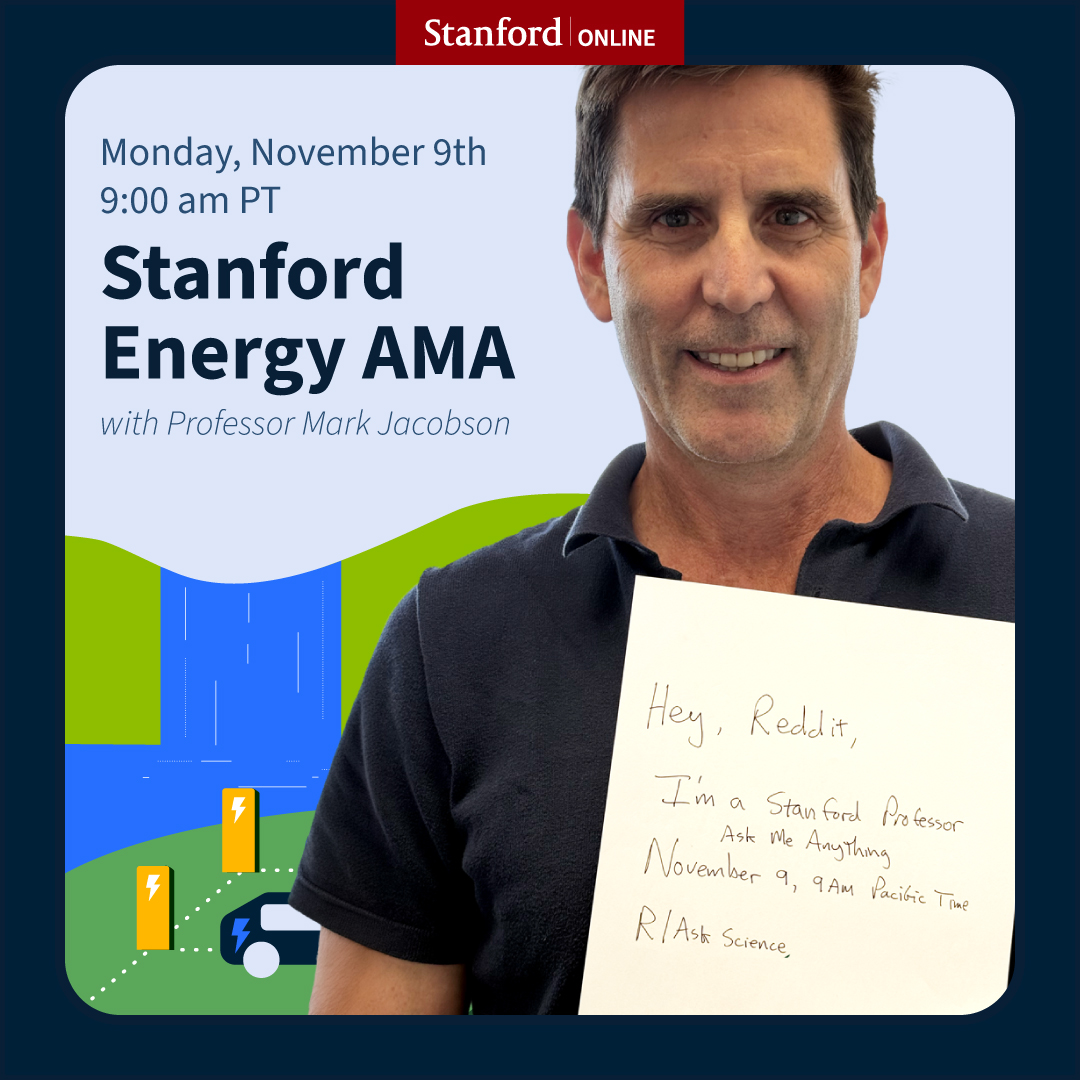
Hi r/AskScience! I’m Mark Jacobson, Professor of Civil and Environmental Engineering at Stanford and Director of the Atmosphere/Energy Program. I did an AMA here in 2021 and I’m glad to be back. I’ll be answering Monday, November 9th from 9:00am PT (12 ET, 17 UT) from the Stanford Online account.
Verification photo: https://learn.stanford.edu/rs/194-OCQ-487/images/Energy-Reddit-AMA_1080x1080.jpg?version=0
My work is on understanding and solving the interconnected problems of air pollution, global warming, and energy insecurity. To understand these problems, I built and applied a three-dimensional atmosphere-biosphere-ocean model to simulate air pollution, and climate. To solve, them, I developed a computer code to simulate grid stability under 100% renewables and authored concrete roadmaps to transition cities, states, and countries to 100% renewable energy across all energy sectors. Ultimately these plans provided the scientific foundation and inspiration for the Green New Deal and other policies worldwide. I have authored ~200 peer-reviewed papers and seven books, including one in 2026, Still No Miracles Needed.
Today’s the opening of the UN COP31, so a lot of these questions are in the air right now. I’m not a negotiator, so I’ll leave that part to them — happy to dig into the science and engineering underneath whatever you’re curious about.
Ask me anything about:
Let’s talk about clean energy, what works, what doesn’t, and what the numbers really say.
Username: /u/Stanford_Online
u/ShahVahan ·
Will you be at COP31? I’m just curious 🧐
u/Stanford_Online · brief
No, unfortunately I will not be there.
u/Lationous ·
hello! A few please:
That will probably be a lot to unpack, sorry c: papers really welcome as references
u/Stanford_Online ·
New conventional nuclear takes 17-23 years in North America and Europe and 12-23 years worldwide from planning to operation versus 1-5 years for new wind or solar, so no matter how much people want nuclear, it cannot be scaled at the same pace. On top of that, the cost is ~$16/W (Vogtle 1 and 2) and similar reactors in Europe v $1/W for new wind/solar. In addition, new nuclear emits 9-37x the CO2/kWh as new wind (Table 3.5 here https://web.stanford.edu/group/efmh/jacobson/Articles/I/NuclearVsWWS.pdf) and has four additional energy security risks: weapons proliferation risk due to nuclear energy proliferation (the Iran war was directly caused by this); meltdown risk; and radioactive waste disposal risk; underground uranium lung cancer risk from radon.
Batteries are extremely useful. California's main grid now has 17.28GW/69.12 GWh of batteries on its main grid, and these can meet up to 72% of the grid's average power demand (24 GW) for 4 hours or about 35% of its peak demand (50 GW) for 4 hours at a cost of only $0.003/kWh-grid electricity output. Batteries can ramp to 100% power from 0 in 20 milliseconds versus 300 seconds for an open-cycle gas turbine.
Coal produces more health-affecting air pollution damage per kWh than gas, but gas produces higher greenhouse gas/warming particle emissions over a 20-year time period than coal (accounting for methane, black carbon, sulfate, and CO2) and only slightly lower GHG/particle emissions over a 100 year time frame. Yet a combination of oil and gas mining and combustion for all purposes cause 90,000 air pollution deaths in the U.S. Both gas and coal are bad for health and climate.
A common dubious claim is that we "need" gas or "need" coal or "need" nuclear to keep the lights on. None is needed.
u/gavgav ·
If you have an unlimited budget and power, what would you do?
u/Stanford_Online ·
Deploy, deploy, deploy existing WWS technologies as fast as possible. Here is a summary of WWS technologies
https://web.stanford.edu/group/efmh/jacobson/Articles/I/WWSDiagram.pdf
We have 97% of these technologies, and what we don't have (long-distance aircraft and ships, for example, their solution can be commercial within 10-15 years if we put effort into it).
We should focus the funds on these solutions and not on solutions proposed by the fossil fuel industry (carbon capture, direct air capture, blue hydrogen, electrofuels), agricultural industry (biofuels, biomass), or nuclear industry (small and large nuclear reactors).
u/ThePineapple3112 ·
Hello! I am a mechanical engineer and I was wondering what do you think will be the main catalyst for solar power storage; a breakthrough in lithium battery technology or a breakthrough in CSP materials that hold the heat? Or do you think there will be something else that allows solar energy to act more like a baseload energy source?
Thank you!
u/Stanford_Online ·
Batteries are already being added on a massive scale in California, Texas, South Australia, and China. In California, the cost for 17.28 GW/69.12 GWh of batteries supplying 72% of the main grid's average power (24 GW) for 4 hours per day is only $0.003/kWh-grid-electricity produced, which is 1/100th the cost of grid electricity. A combination of wind-solar-geothermal-and-hydro in the state have already produce baseload power of 12.8% of all demand in all of 2026 (in other words, they never supplied less than 12.8% of demand for any 5-minute period), versus nuclear, which never supplied less than 6% and never more than 12%.
Adding batteries to this only smoothens out the supply more.
u/akiptif ·
What are the three biggest obstacles to getting the world to run on solar, wind, and water energy?
u/Stanford_Online ·
u/The_Weekend_Baker ·
My question is about carbon capture (DAC), and more specifically the physics/thermodynamics involved.
The Wiki page on gasoline, for example, indicates that "By weight, combustion of gasoline releases about 46.7 megajoules per kilogram," and my very rudimentary understanding of physics is that reversal of a chemical reaction requires, at a bare minimum, the same amount of energy as was originally released. So is it safe to assume that capturing 1 kg of CO2 from the atmosphere would require 46.7 megajoules of energy, and probably much more because a DAC system is very unlikely to be operating at 100% efficiency?
Thanks for your time!
u/Stanford_Online ·
The Iceland Climeworks DAC plant, which runs on geothermal electricity and heat , requires 5,000-6,000 kWh-electricity+heat per tonne-CO2 removed from the air, according to the Climeworks CEO (p. 3041 here)
https://web.stanford.edu/group/efmh/jacobson/Articles/I/149Country/149-Countries.pdf
That is equivalent to extracting 167-200 g-CO2 per kWh-electricity and heat.
However, because WWS electricity and heat (e.g., from geothermal) are limited, if they are used for air capture, they cannot be used to replace a coal or fossil-gas electricity or heat source.
Using one kilowatt-hour of WWS electricity to replace coal electricity eliminates about 1,380 grams of carbon dioxide-equivalent emissions over a 20-year time frame (930 from coal combustion and 450 from coal mining). Thus, using WWS electricity for air capture instead of for replacing coal electricity increases CO2 in the air by a factor of 7 to 8.
Using WWS for air capture instead of for replacing coal for electricity also prevent the elimination of air pollution, mining, and infrastructure associated with the coal plant.
In the present case, Iceland produces no coal electricity. However, Iceland is increasingly using coal for industrial heat. Coal for heat emits about 440 grams of CO2-equivalent per kilowatt-hour of fuel energy. Mining of coal is another 450 over a 20-y time frame, for a total of 890, so using geothermal for DAC increases CO2 emissions versus using geothermal to replace coal for heat by a factor of 4.5-5.3.
u/akiptif ·
How would you build data centers that would do minimal civil and environmental damage to the Earth and mankind?
u/Stanford_Online ·
If data centers have to be built, they can be powered with 100% WWS in five ways:
a) With utility or near-site EGS
b) Combination of utility wind, utility solar, on-site batteries, and on-site hydrogen fuel cells.
c) Combination of utility wind, utility solar, and on-site batteries.
d) Combination of utility wind, utility solar, and on-site hydrogen fuel cells
e) Distributed rooftop solar with on-site batteries and hydrogen fuel cells (data center owners would pay to install solar on residential, commercial, and industrial buildings to reduce grid demand for those buildings, freeing up electricity for the data center).
u/akiptif ·
Regarding air pollution, global warming, and energy insecurity, what are three of the most important factors that you would like to public to know about each of these items?
u/Stanford_Online ·
Air pollution causes about 7.4 million deaths per year worldwide, costing the world ~$30 trillion/year in terms of statistical cost of life and morbidity. Global warming will cost that in 2050 and is already causing significant damage. Energy security is a third problem that can result in economic, social, and political instability. These problems are intertwined. Any solution must address all three simultaneously, not just climate; not just air pollution; not just energy security.
Yet, many of the solutions proposed today (e.g., carbon capture, direct air caputre, blue hydrogen, electrofuels, biomass, biofuels, small and large nuclear) try to address just one - climate. This is a mistake. Not only are most of these proposed solutions not useful at all for addressing climate, but most increase air pollution and energy insecurity. Here are some papers and book chapters addressing these issues:
https://web.stanford.edu/group/efmh/jacobson/Articles/I/149Country/149-Countries.pdf
https://web.stanford.edu/group/efmh/jacobson/Articles/Others/23-E85vBEVs.pdf
https://web.stanford.edu/group/efmh/jacobson/Articles/Others/21-GreenVsBlueH2.pdf
https://web.stanford.edu/group/efmh/jacobson/Articles/Others/19-CCS-DAC.pdf
https://web.stanford.edu/group/efmh/jacobson/WWSStillNMN/SNMN-WhyNotCCorDAC.pdf
https://web.stanford.edu/group/efmh/jacobson/WWSStillNMN/SNMN-WhyNotNuclear.pdf
https://web.stanford.edu/group/efmh/jacobson/WWSStillNMN/SNMN-WhyNotBioenergy.pdf
u/akiptif ·
How far away are we from achieving significant reductions in air pollution, global warming, and energy insecurity?
u/Stanford_Online ·
From a technical point of view, we have 97% of the technologies we need to solve all three problems. From an economic point of view, the costs of these technologies are either low enough or almost low enough to deploy them on a massive scale.
The main issues still are social and political. However, even from a social and political point of view, we are further along today than in 2009, when we first started working on developing energy plans for countries and states. Part of the reason is that many more technologies are now available and their costs have dropped, and this has resulted in more people adopting WWS technologies, appliances, and machines, giving more people confidence that such a system works. In addition, education about the benefits of WWS over other systems has helped reduced some people's concerns. Finally, solutions proposed by the fossil fuel, agricultural and nuclear industries have only exacerbated problems, so more and more people realize that these solutions are damaging, helping to focus more attention on the solutions that do work.
u/akiptif ·
What can the average individual do to help facilitate your work?
u/Stanford_Online ·
Aside from implementing WWS in their own homes (electric induction cooktops, heat pump water heaters, heat pump air heaters and air conditioners, insulation, telecommuting, etc.), support policies promoting electrification of buildings and using more renewable electricity, and educating friends and families about the benefits.
u/akiptif ·
What have been the hardest civil and environmental engineering problems? you still have to solve in order for this endeavor to become practical
u/Stanford_Online ·
The 3% of technologies that are not yet commercial but needed to solve the air pollution/climate/energy security problem include long-distance aircraft and long-distance ships along with other long-distance heavy military vehicles. A potential solution for these is hydrogen-fuel-cell-electric aircraft/ships/military vehicles
https://web.stanford.edu/group/efmh/jacobson/Articles/Others/22-BEH2Vehicles.pdf
However, if lithium-air batteries come to fruition at scale, they can obviate the need for H2 for long-distance, heavy transport. Note that passenger vehicles and most travel <1,000 km should be done by batteries rather than H2.
u/Thick_Ad_3631 ·
How do you manage the frustration and persist when partisanship derails policy into which you've put so much effort?
u/Stanford_Online ·
I try to stay positive knowing that we have a technical and economic solution that will benefit most everyone in terms of health, climate, energy security, costs, jobs, land use and land destruction. I am also encourage by the fact that every year, the world is moving, albeit slowly, toward 100% clean, renewable energy. Here is a paper on how fast the world and individual countries are moving.
https://web.stanford.edu/group/efmh/jacobson/Articles/I/150Country/150WWSProjections.pdf
u/lambertb ·
How much fossil fuel will it take to mine, transport, refine, manufacture, transport, assemble, maintain, and scrap the amount of material required to globally scale these energy sources? Doesn't global scaling imply a very large carbon commitment?
u/Stanford_Online ·
Already 31.6% of all electricity in the world in 2025 was met with WindWaterSolar (8.54% wind, 13.97% hydro, 0.28% geothermal, and 8.75% solar)
https://web.stanford.edu/group/efmh/jacobson/WWSBook/Countries100Pct.pdf
Heat for industry was not so far along.
However, if we obtain 100% WWS across all energy sectors by 2050, this means that every year, more and more electricity and heat used to build the infrastructure will be WWS electricity and heat and less and less will be fossil.
In addition, by moving to WWS, we avoid the use of energy to mine fuels. About 10.6% of all energy worldwide is used just to mine fuels, so we eliminate that energy use by 2050, and gradually before then.
We also avoid building new fossil fuel infastructure.
So, the determination of how much fossil fuel energy and emissions will take to build the WWS infrastructure requires accounting for all these factors. It is much less than simply looking at today's emissions per unit energy needed and multiplying through by energy needed.
u/TastiSqueeze ·
The world consumes from all sources about 21 billion kilowatt hours of energy every hour. Considering all fossil fuel sources, we have maybe 100 years of energy on this scale. We will exhaust coal, gas, oil, etc. Geothermal, solar, wind, hydro, wave, and all similar renewables have various limitations either from scope or from necessary means of storage. Nuclear fission is expensive but can be reliable. It has limits due to cost, radioactive materials, and waste disposal. Fusion could do the job but will be expensive and realistically is not technically achievable for the near future.
How do we financially move from our current fossil fuel dependence over to solar given the massive investment required to deploy solar hardware including batteries? Note that I am not arguing whether or not solar is the best option. It is the ONLY long term viable option at this point.
u/Stanford_Online ·
The financial and other benefits of moving to WWS are so large, that countries and individuals have a financial incentive to do so. The problem has been that almost no-one is aware of the benefits. Here is a summary
https://web.stanford.edu/group/efmh/jacobson/Articles/I/150Country/25-WWS-150Countries.pdf
from this paper
https://web.stanford.edu/group/efmh/jacobson/WWSBook/Countries100Pct.pdf
Reduces 150-country 2050 annual energy costs by 60.6% (from $17.2 to $6.78 tril/y);
Reduces annual energy, health, plus climate costs by 92.2% (from $86.6 to $6.78 tril/y);
Reduces 2050 all-purpose, end-use energy requirements by 54.2%;
Creates 28.0 million more long-term, full-time jobs than lost (not including increases in jobs in producing electric appliances, vehicles, machines).
Saves 5.6 million lives/y ($36.9 tril/y) from air pollution in 2050 among 150 countries;
Eliminates 56.1 bil tonnes-CO2e/y ($32.5 tril/y in climate costs) 2050 among 150 countries;
distribution. The payback time due to WWS annual energy cost savings vs. BAU is 5.8 years; that due to annual energy+health+climate cost savings is 0.75 years;
New WWS requires 0.18% of the 150-country land for footprint, 0.39% for spacing;
u/cryptoraptor · edited
Edited on Reddit after the archive saved it; this is the original.
Hello Professor Jacobson, thanks for doing this AMA!
For grid-scale storage in a 100% renewable system, which technologies do you see as most future-proof? Do high-temperature molten salt batteries still look promising? Do solid-state batteries matter for the grid, or mainly for EVs? Where do flow batteries, metal–air electrochemical cells, and thermal storage fit alongside lithium-ion?
Thanks again for your work!
u/Stanford_Online ·
I support all the battery types you listed. Fortunately, lithium ion prices have dropped so low that LI batteries are being deployed on a massive scale in many parts of the world. Costs of some of these other batteries have similarly dropped. The more the competition among battery types, the lower all battery costs will go, the more all batteries will be deployed.
I believe a specific focus on even higher-density batteries for use in long-distance aircraft and ships would be beneficial. To that end, hopefully lithium-air batteries will pan out. Otherwise, for stationary electricity storage, density is much less of an issue.
u/DonkeyPotato ·
I spend a lot of time in the Southern California desert, and have seen huge tracts of land being turned into solar farms. It gives me a bit of the ick that we’re trading one form of environmental damage for another (albeit probably much less bad).
Policy issues aside, if we maximized solar installs on existing roof space and new construction, how close does that get us to fossil fuel independence? Is it possible to fix our energy woes without having to tear up large swathes of wild spaces?
u/Stanford_Online ·
The fossil fuel industry currently occupies ~1.16% of all U.S. land, including Alaska. The ethanol industry occupies another 1.24% of land just to grow corn to supply only 4% of U.S. transportation energy. The total is thus 2.4% of all U.S. land is occupied for energy
https://web.stanford.edu/group/efmh/jacobson/Articles/I/LandFossil.pdf
Transitioning the U.S. to 100% Wind-Water-Solar for all energy purposes requires less than 1% of all U.S. land
https://web.stanford.edu/group/efmh/jacobson/Articles/I/21-USStates-PDFs/21-USStatesPaper.pdf
that includes mostly land for utility PV and onshore wind. In other words, transitioning the U.S. reduces land requirements significantly.
What is more the growth of land use over time in the future with WWS will be much less than with fossil fuels because most land for fossil fuels is for mining fuels - e.g., 50,000 new oil and gas wells are drilled yearly in central North America just to maintain fuel supplies. This results in more abandoned wells and land destruction each year. WWS resources require no mining for fuels because wind comes right to the turbine and sunlight comes right to a panel. This is why WWS is cheaper - no fuel cost.
u/Batou2034 ·
How will militaries fight wars without oil? (essentially, an electrifying transportation question)
u/Stanford_Online ·
It is possible to electrify all military transport (primarily hydrogen-fuel-cell electric for long-distance, heavy transport but also battery electric f for everything else).
https://web.stanford.edu/group/efmh/jacobson/Articles/Others/22-BEH2Vehicles.pdf
Plus military bases can be all electric
https://web.stanford.edu/group/efmh/jacobson/Articles/Others/21-REforFOBs.pdf
u/Consistent-Egg-4659 ·
Is there a way we could adapt trains to this project that'd make them widely accessible and/or affordable too?
u/Stanford_Online ·
Our roadmaps include trains and all other transport. Most trains will be either on an electric track or, in some cases, have batteries for non-electrified portions of track.
u/DK_Thrall ·
What would be the most effective way of producing energy which optimizes both environmental balance and the economical output.
u/Stanford_Online ·
A wind-water-solar system
https://web.stanford.edu/group/efmh/jacobson/Articles/I/WWSDiagram.pdf
addresses global warming, air pollution, and energy security at much lower cost than the current system. Here is a paper and individual summaries for each country that quantifies the benefits versus a business-as-usual system in 150 countries
https://web.stanford.edu/group/efmh/jacobson/Articles/I/WWS-150-Countries.html
u/Ok_Umpire_8108 ·
How will decentralizing and democratizing energy access (e.g. modular plug-in solar panels, hydropower kits) contribute to changing energy budgets in the developing world?
Do you think existing institutions can sufficiently share the policy information and tech needed for globally implementing clean energy?
u/Stanford_Online ·
Distributed energy systems (mostly solar PV and batteries) have enormous benefits not only to people in developing countries with little access to energy, but also to those with grid connections and to those on the grid without grid connections. Here is a detailed summary of the benefits of distributed PV.
https://web.stanford.edu/group/efmh/jacobson/WWSNoMN/DistributedPV.pdf
u/Positivelylmpaired ·
Hi Professor Jacobson, thank you for doing this. I have multiple questions so i apologize in advance.
I've read solar is a highly promising energy source given massive decreases in costs of batteries and PV's, with (if i recall correctly) ourworldindata stating solar to be cheaper than other (even non-renewable) alternatives in many regions.
How do you predict developments in solar energy will continue, are further strong decreases in cost expected or are we steadily reaching a plateau? Given how competitive solar currently is with fossil fuels, it feels intuitive to me that even further improvements in solar would have a immense impact on the viability of fossil fuels in the future, but i may be mistaken.
What will the share of the total capacity of solar energy be relative to the other renewable sources available (will it still remain the largest or might its share grow even bigger?)
What are the main barriers expected for solar energy in the upcoming future?
Many thanks!
u/Stanford_Online ·
Ultimately, up to half or more than half of all world energy for all purposes can be powered by solar (with the rest powered by a combination of wind, hydro, and enhanced or conventional geothermal).
https://web.stanford.edu/group/efmh/jacobson/Articles/I/150Country/150-CountriesEGS.pdf
PV costs are continuing to drop, and PV is being deployed on a massive scale worldwide, particularly in China.
This paper, for example, provides the rates of growth of PV, wind, and hydro in all countries of the world
https://web.stanford.edu/group/efmh/jacobson/Articles/I/150Country/150WWSProjections.pdf
I expect these rates to increase over time with better and better PV efficiencies and lower costs.
u/hiuslenkkimakkara ·
Prof. Jacobson, being from Finland I'd like you to give an opinion of the Finnish discourse of future power and heat needs. Currently, the policy discussion seems to be to retain current hydro, as there is no way to expand it. Wind power could be mildly increased, but defence requirements limit it as it hampers air search radars. Solar is being developed, but the biggest interest is towards nuclear in the form of mini-reactors.
I'm by no ways an expert, but from what I gather the idea is to build lots of mini reactors just for district heating in order to replace burning garbage and wood pellets. Is this a more sustainable approach than to say, licence a variant of GE's S6G PWR and run it as a ground installation? Navy reactors are the safest around, after all. And we've got the Onkalo final deposit site so waste is not an issue.
u/Stanford_Online ·
For countries where wind, solar, and hydro have some limits, enhanced geothermal is a commercial technology that is now available and can be installed economically over 25% of land on Earth, including parts of Finland
https://web.stanford.edu/group/efmh/jacobson/Articles/I/150Country/150-CountriesEGS.pdf
EGS can do everything that nuclear does (since EGS provides baseload electricity) but faster, less expensively, cleaner, and safer. Finland's recent nuclear plant took 23 years from planning to operation, and small modular nuclear does not even exist commercially, so there is no reason to think it will take less time.
In addition, here is a plan for Finland that relies only on wind, solar, and existing hydro, with no EGS
https://web.stanford.edu/group/efmh/jacobson/Articles/I/150Country/25-WWS-Finland.pdf
u/Kirkaiya ·
I'm curious what your opinion is on how long it will be before storage capacity (grid-level) will be sufficient to meet most baseline power requirements, allowing us to phase out the fossil-fuel plants that provide much of it currently. Are we looking at 2045, 2060, or later?
u/Stanford_Online ·
Grid battery storage in California, Texas, South Australia, and China have all ramped up far faster than this.
In just three years, for example, California's main grid (CAISO) has added so much that it now has 17.28 GW/69.12 GWh of batteries, enough to power 72% of the average power demand on the grid (24 GW) for 4 hours or 35% of the peak demand for 4 hours. hese batteries can also shift the time of output for up to 12% of the daily electricity use on the grid. Prices have dropped so low that, if bought today, these batteries would cost $0.003/kWh-grid-electricity produced, which is 1/100th the residential retail price of grid electricity in the state. T
More and more battery options are becoming available, so I expect prices will continue to drop and battery growth to explode and meet far more power in far more locations by 2030.
u/Tremodian ·
I’ve seen anti-renewable energy arguments that solar panels and turbines turn into “unrecyclable industrial waste.“ how true is that? More broadly, how does the renewable energy industry make sure it is a net environmental positive?
u/Stanford_Online ·
Solar panels can be recycled. During recycling, 80-95% of the mass of the panel is recycled. Similarly, more than 95% of battery components can be recycled.
More relevantly though, solar panels now last up to 35 years and require no mining of sunlight for their fuel since the sunlight comes right to the panel. In comparison, coal, gas, and oil need to be mined every day to provide electricity from a combustion power plant. All the waste from burning that fuel ends up in our lungs as air pollution gases and particles, in our water, in our air, and on our soil. So the mass waste from the combustion of fossil fuels and bioenergy fuels is orders of magnitude larger and more dangerous to our health (7.4 million people die of air pollution annually) than the waste from solar panels, even if they were not recycled.
u/ghostoutlaw ·
Do you think it would make sense to dedicate the next decade of global battery production (all battery production capacity, including even AA, AAA, C, D and 9V battery production) exclusively to the US to enable non-demand generation power sources just to meet todays demand?
Or is there a battery technological leap that would increase battery capabilities by about 100x that we don't yet know about that is starting production tomorrow?
u/Stanford_Online ·
Every WWS technology, which includes, generation, storage, and electric devices and machines, that replaces a conventional-fuel technology will have an immediate health, climate, cost, job, and land benefit, so yes we should deploy what we have as fast as we can and not wait for the next big breakthrough.
Nevertheless, there are some potential breakthroughs that can help. For example, if lithium-air batteries pan out, they can allow for long-distance aircraft and ships to be powered with batteries rather than hydrogen fuel cells.
u/QuietRulrOfEvrything ·
I would like to do wind, solar and water powered production in upstate New York near West Point & the Hudson river. How do I break into the field without turning into a Mister Burnes sterotype? I do want less dependence on fossil fuels, but I'd be lying if I said that I'm willing to get involved while unpaid or for free on a strictly volunteer basis.
u/Stanford_Online ·
It is great that you are interested in this field. There are also related technologies, such as enhanced geothermal, firebricks, ground-source heat pumps (https://dandelionenergy.com), air source heat pumps, EVs, batteries, etc., where jobs are needed. Aside from possibly online classes that can help catch you up to speed in some of these industries, possibly finding a recruiter, or consulting with the solar, wind, and other trade associations to see where jobs are available could help.
u/boghall ·
CCS has completely failed to scale up. In practical terms it seems it doesn’t and isn’t going to work. It’s clear why some industries would keep pushing it: because it gets them off the hook and lets them continue with profitable BAU for longer. But why do governments continue to throw money at it and keep peddling what increasingly seems to be a distracting fantasy that it will ever play a significant part in emissions reduction.
u/Stanford_Online ·
The fossil fuel industry has been pushing four technologies to keep itself in business: carbon capture, direct air capture, blue hydrogen, and electro fuels. The industry convinces governments to subsidize these technologies, claiming falsely that they help with climate. Yet, they all simply increase CO2, air pollution, fossil mining, fossil infrastructure, air pollution deaths, climate damage, land use, and total social costs:
https://web.stanford.edu/group/efmh/jacobson/Articles/I/149Country/149-Countries.pdf
What is more, 74% of all CO2 captured in the world to date is used for enhanced oil recovery, a process by which 50-120% of the CO2 captured goes right back to the air. Due to the energy requirements of the capture equipment, all carbon capture and direct air capture increase CO2 rather than decrease it, relative to investing the same money in using renewables simply to replace a fossil source.
u/superSmitty9999 ·
One concern I have about solar is the total life cycle and recyclability of the components. Do you know how intrinsically toxic solar panels are if left to decay and how much more they would cost if you factor in full circle recycling?
u/Stanford_Online ·
Solar panels can be recycled. During recycling, 80-95% of the mass of the panel is recycled. Similarly, more than 95% of battery components can be recycled. I am not familiar with the costs of recycling, though.
More relevantly though, solar panels now last up to 35 years and require no mining of sunlight for their fuel since the sunlight comes right to the panel. In comparison, coal, gas, and oil need to be mined every day to provide electricity from a combustion power plant. All the waste from burning that fuel ends up in our lungs as air pollution gases and particles, in our water, in our air, and on our soil. So the mass waste from the combustion of fossil fuels and bioenergy fuels is orders of magnitude larger and more dangerous to our health (7.4 million people die of air pollution annually) than the waste from solar panels, even if they were not recycled.
u/W02T ·
How does energy efficiency play into your work? Wouldn’t it make sense to first save energy by making everything as energy efficient as possible? I know the energy producers wouldn’t appreciate it. But focusing on efficiency first would make the transition to renewables much easier.
u/Stanford_Online ·
Electrifying all energy worldwide and providing the electricity with WWS reduces end-use energy needs by around 54% for five reasons: the efficiency of battery-electric over combustion vehicles; the efficiency of electric heat pumps over combustion heating; the efficiency of electric high temperature furnaces over combustion furnaces; eliminating the energy to mine, transport, and refine fossil fuels and uranium, and end-use efficiency improvements beyond those in a business-as-usual case
https://web.stanford.edu/group/efmh/jacobson/Articles/I/150Country/150-CountriesEGS.pdf
Thus, efficiency is very important, but most of the efficiency comes naturally due to a transition. Only ~6.6% of the 54% is due to more efficient appliances and machines and reducing energy use.
u/stickmaster_flex ·
Edited on Reddit after the archive saved it; this is the original.
Hi Professor Jacobson,
My questions upfront:
Are single family homes a viable option for a sustainable future, or are we fooling ourselves that a large fraction of families can live in a separate structure without massive environmental costs?
Assuming people are able to move to an all-electric lifestyle (as I have), what are the most effective technologies we can install to increase our impact? Are home solar and home grid-connected batteries more greenwashing, or are they actually impactful?
As background, I live in the Northeast Corridor (a few dozen miles north of Boston) and due to unforeseen circumstances had the chance to build a new single family home in a relatively dense suburban neighborhood. I went all-electric, built on an insulated slab instead of having a basement, put in 8" of wood fiber insulation followed by 4" of polyiso rigid insulation, high-efficiency air-source heat pumps, heat pump water heater, induction stove, double-paned windows, literally everything I, my contractor, and a home efficiency expert could come up with to improve our home's efficiency within our budget.
u/Stanford_Online ·
I think the answer varies by countries and population density. Our plans are based on the assumption people will continue to live as they currently do. We can certainly provide energy for such homes, but whether we keep them is something I don't try to answer.
In a home, an electric induction cooktop, electric heat pump water heater, electric heat pump air heater and air conditioner, insulation and weatherization, LED lights, more energy efficient appliances, electric vehicles.
Home solar and batteries are extremely beneficial. Here are multiple reasons why
https://web.stanford.edu/group/efmh/jacobson/WWSNoMN/DistributedPV.pdf
u/aerx9 ·
It seems like proponents of various energy technologies push misleading info about costs (and environmental costs as well as monetary), especially related to the entire lifecycle. Nuclear proponents never talk about the cumulative increasing cost of dealing with long-term waste such as recasking (and the current situation relies on storage insitu at facilities, for which security is a major cost), and rely on government subsidies for waste handling rather than building in the true cost to customers. Solar (and wind) - forgive the shorthand - fail to include recycling lifecycle costs. Battery storage fails to mention the environmental cost. Of course fossil fuels want to leave out the pollution and carbon impact. Other tech like transmission and alternative storage gets scant mention. I would say this indicates a lack of serious commitment to dealing with all the issues by the collective industries and has harmed the discussion as a whole and removed trust. What can be done to get the discussion back on track?
u/Stanford_Online ·
I think most published papers attempt to quantify private costs in detail, but you are right that proponents in the public often cherry pick results or provide their own numbers that come out of the blue. In both published papers and the public, though, what is usually missing are health and climate and other environmental costs. I think the more we point out what is missing or the errors in private cost calculations, the more people will be aware and alert and be able to make better decisions.
u/redly ·
I vaguely remember a Stanford publication that suggested a 150% overbuild of wind/solar would allow complete electrification without needing storage.
I haven't been able to find the paper, and my octogenarian memory is not to be trusted. Does something like this analysis seem possible?
u/Stanford_Online ·
The overbuild needed for generation is 6-15% rather than 50%, as seen in Table S8 here
https://web.stanford.edu/group/efmh/jacobson/Articles/I/150Country/150-CountriesEGS.pdf
u/Da_Wei_23 ·
Thank you for this AMA, Professor Jacobson. I read Still No Miracles Needed and agree that rapid electrification is the way to go. I’m a sceptic on implementation, though.
For Germany, your 2050 roadmap means going from ~10 to ~72 GW offshore wind (a build rate roughly 8× today’s) and from ~68 to ~230 GW onshore. My bigger concern is winter: low solar output and multi-day to two-week Dunkelflaute periods. Your Europe results rely on ~74 TWh (electric-equivalent) of underground heat storage and 2.9 TWh of pumped hydro. Scaled to Germany’s share of demand, that’s ~12 TWh electric-equivalent, or ~48 TWh of heat. Today the world has roughly 0.7 million m³ of pit storage, perhaps 50 GWh.
Does the German winter balance still close if interconnection to Nordic/Alpine hydro is constrained, or in a worse weather year than the three you simulated? Germany would effectively swap fuel-import dependence for dependence on neighbours’ hydro and grid links. And what’s a realistic path from today’s handful of pit storages to tens of TWh? What does covering the last few percent (a two-week continental Dunkelflaute) cost in your model? How does that compare with a firm low-carbon backstop, whether hydrogen turbines or nuclear? Why do you reject the latter even as a small complement to wind, solar and storage?
Thanks again. First post in 10 years, because I really care.
u/Stanford_Online ·
Germany is interconnected to Europe, and interconnection would allow its grid to stay stable even if no wind or solar persisted
https://web.stanford.edu/group/efmh/jacobson/Articles/Others/21-CountriesVRegions.pdf
Plus, when it is cold outside, it is usually windy rather than calm, and this is for meteorological reasons
https://web.stanford.edu/group/efmh/jacobson/Articles/Others/21-Wind-Heat.pdf
Also, enhanced geothermal is now commercial, and Germany has good EGS resources so this is an additional option
https://web.stanford.edu/group/efmh/jacobson/Articles/I/150Country/150-CountriesEGS.pdf
Finally, batteries are now very inexpensive. California build 17.28 GW/69.12 GWh onto its main grid, mostly in the last 3 years, and these supply 72% of the grid's average power (24 GW) for 4 hours each day at 35% of its peak power (50 GW) for 4 hours at a cost of only $0.003/kWh-grid-electricity at today's battery prices, and this is only 1/100th the residential retail price of grid electricity in the state. So, Germany has numerous options for keeping the grid stable with 100% WWS.
u/Zealousideal-Gene272 ·
Hello Professor!
Do you think foundational AI models developed specifically for grids can help reduce curtailment of renewable energy produced? Because in our part of the world (India) we have a very dense decentralised grid structure with most of the solar energy produced has to be curtailed due to unavailability of storage and transmission assets. Is investment in transmission and storage assets the only way?
If you want to recommend any research paper addressing this topic, please help me with it.
u/Stanford_Online ·
Yes, I am fairly sure some software that incorporates AI will be developed that will improve the efficiency of grids and reduce curtailment. I don't have a recommended paper at this time though.
u/HHS2019 ·
Thanks for doing this. What is the realistic sales pitch to developing countries that they should build infrastructure and use fiscal policies that curb GHG emissions -- but potentially bring additional costs to their citizens, when the vast majority of the already GHG already present were released with little to no regulation or oversight by countries who got ahead economically as a result?
u/Stanford_Online ·
Every country will benefit enormously from a transition in terms of annual energy costs, health costs, climate costs, and air pollution deaths and morbidities. This is why China is undergoing a wholeale transition to WWS
https://web.stanford.edu/group/efmh/jacobson/Articles/I/150Country/150WWSProjections.pdf
Most countries will increase the numbers of long-term, full-time jobs and reduce land requirements relative to their current energy system.
u/SmartAssaholic ·
Considering energy density how close would electric in airplanes be in a full battery configuration to current ICE output?
How much energy loss from thermal?
u/Stanford_Online ·
With current or near-future technology, hydrogen-fuel-cell-electric is better than battery electric for long-distance (e.g., 747-type) aircraft. For short- and medium-haul flights, though, battery electric can work.
https://web.stanford.edu/group/efmh/jacobson/Articles/Others/22-BEH2Vehicles.pdf
However, if lithium-air batteries pan out, that would change the potential for batteries to run long-distance aircraft tremendously.
u/Absentia_07 ·
Whats a business one can invest in, that saves us from climate change and also a great business to step into right now?
u/Stanford_Online ·
Any business related to these technologies should experience significant growth.
https://web.stanford.edu/group/efmh/jacobson/Articles/I/WWSDiagram.pdf
u/canvascoloredin ·
Hi Professor Jackson! Thank you for doing this. Would you say people who don't believe in climate change, who do not have significant influence over climate change policy pose as large a threat as people give them credit for?
u/Stanford_Online ·
I think they are distracting and not helpful. However, I think the people causing more damage are those pushing damaging solutions such as carbon capture, direct air capture, blue H2, electro fuels, biomass, biofuels, and new small and large nuclear reactors.
u/Stanford_Online ·
Thanks to everyone who asked questions today.
The technologies we need already exist, and the costs are already low enough. What’s left is deployment, and focusing on what really works.
All of my papers, free: https://web.stanford.edu/group/efmh/jacobson/
My latest book, Still No Miracles Needed, with links to sample material: https://web.stanford.edu/group/efmh/jacobson/WWSStillNMN/StillNMN.html
If you want a structured version of all this, I teach a course through Stanford Online: https://online.stanford.edu/courses/xeiet100-clean-renewable-energy-storage-sustainable-future
38 exchanges and 1 host note, with 39 host answers. 77 of the 94 archived comments are shown.
Fetched from the archive on 22 Nov 2026.
Comments removed by Reddit’s AutoModerator are never archived. The archive saves most comments within minutes of posting, but some arrive hours late and a few never do. Upvote counts, used only for the “Most upvoted” order, are frozen at the archive’s capture.
To report a problem or ask for something to be removed, see Corrections and removal.