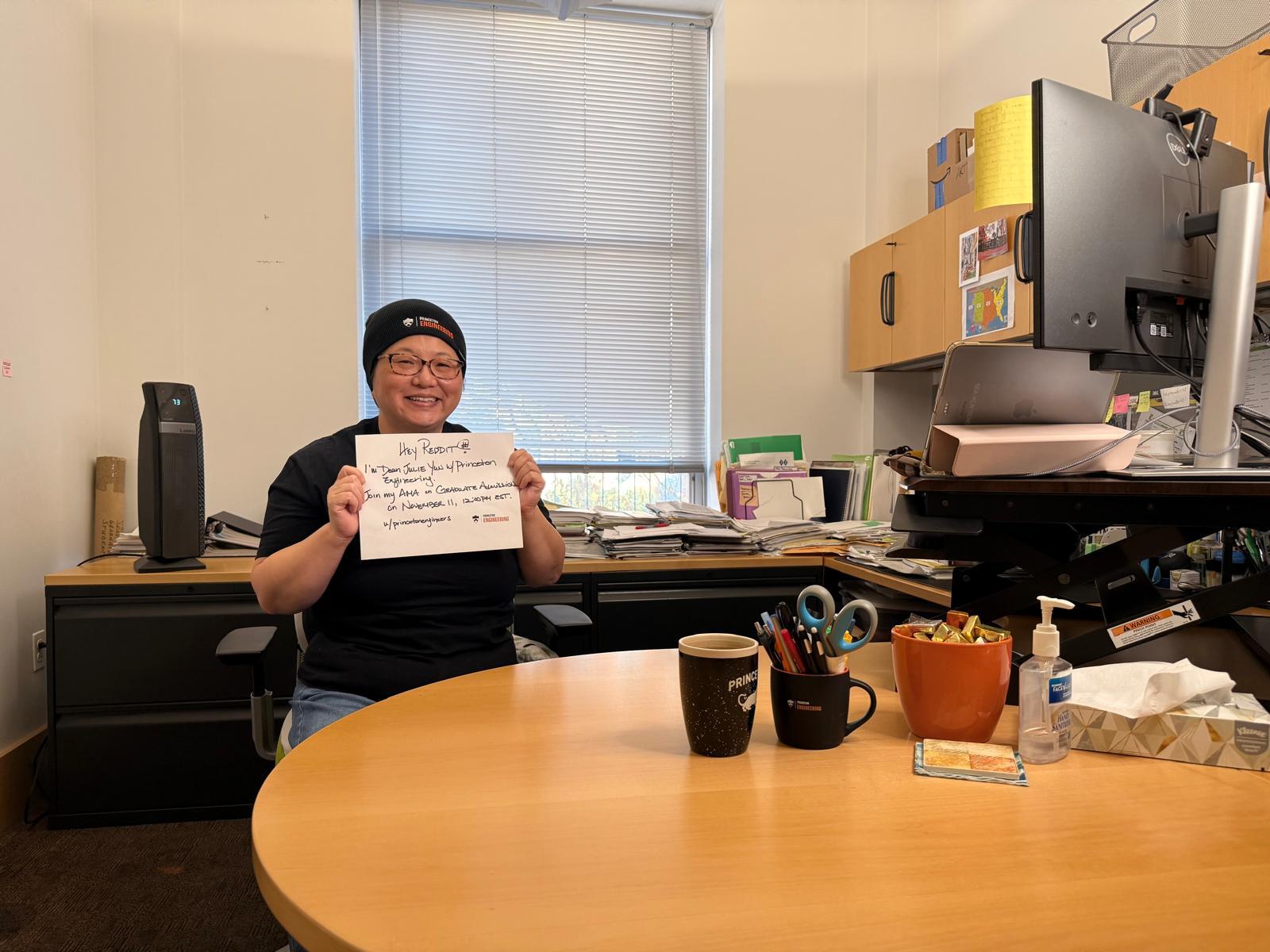
I'm an engineering school dean who specializes in broadening access to graduate school. Ask me anything!
r/IAmA · 16 Nov 2026, 17:01 UTC · posted by u/PrincetonEngineers · 14 answers
Verbatim from the Arctic Shift archive of the Reddit thread, fetched 24 Nov 2026. Text is as the archive first saved it; comments may have been edited or deleted on Reddit since. View the thread on Reddit
Only the hosts’ replies and the comments they replied to; 10 other comments are left out. Times count from the post: +1h05m means 1 hour 5 minutes after it went up.
Read aloud by synthetic voices (Kokoro). The host’s voice is theirs alone; everyone else’s is assigned at random. They are not the participants’ real voices. About the audio
Hosts
u/PrincetonEngineersposted the AMA · flair “Verified” · 14 answers
Introduction
This is the post as the archive first saved it; the host may have edited it since.
I’m Dean Julie Yun from Princeton University’s School of Engineering and Applied Science. I have more than two decades of experience in working with graduate students, guiding them through graduate admissions to the completion of their degrees.
For the past seven years, I’ve been running a program aimed at lowering barriers to access for STEM-focused graduate students and demystifying the process of applying to grad school. That program - delivered free to students regardless of institutional affiliation - has achieved a 90% success rate for participants accepted to R1 programs.
I will be here to answer the kinds of questions students care about most in this grad school application cycle, the same questions we discuss in our workshops — about getting GREAT letters of recommendation, drafting compelling statements of academic purpose, the significance of GREs and GPAs, internships vs research experiences, etc.
I’ll be answering questions Tuesday, November 17, from 12pm to 1pm ET. Ask me anything about grad admissions in STEM!
The irrepressible hope that I see in students despite all the challenges bombarding them today. You still have students who, despite all that's happening politically and technologically, believe in the promise that education holds for them. That educational attainment still gives them an on ramp to pursue their dreams.
2. at all levels of prestige have similar mission statements?
u/GregJamesDahlen ·
do colleges and universities across the u.s. at all levels of prestige have similar mission statements? something like trying to turn out people with good critical thinking, good morality, good skills and knowledge in their chosen field?
u/PrincetonEngineers ·
I can't speak to all university mission statements. Graduate programs in STEM are geared toward training people to think about big open ended problems to solve big challenges facing humanity. To support this, graduate programs are generally looking for people who can think critically about challenging problems, are intellectually curious, and great problem solvers. What you raise about morality is interesting because it reminds us that good science occurs with in a context, and we must be mindful of how our discoveries will be deployed to ensure that we are solving problems and not creating more complex problems.
3. How can one identify opportunities before they become mainstream?
u/Puzzleheaded_irl · edited
Edited on Reddit after the archive saved it; this is the original.
How can one identify opportunities before they become mainstream?
u/PrincetonEngineers ·
What do you mean by opportunities in this case?
4. How and should I reach out to faculty for students in either camp?
u/Asian__Invasion ·
Edited on Reddit after the archive saved it; this is the original.
Hi Dean Yun,
My question is regarding the importance of reaching out to faculty at Princeton engineering during the application cycle for a PhD. I understand some students are sure of their interest and can already filter out the exact faculty they would like to work with. Other students may prefer to use their PhD as another phase of exploration of interest.
How and should I reach out to faculty for students in either camp? How strict is Princeton's comittee based admission? Do professors here generally prefer direct student contact, and do connections play a significant role in student admissions?
Thank you,
Prospective PhD student
u/PrincetonEngineers ·
Are you asking this question because you have been advised that you will increase your chances of being admitted if you make contact with a faculty member at an institution you are interested in applying to? If so, let me give you my hot take: This is BAD advice. Here are the reasons why:
Faculty often don't have time to respond to cold emails, especially during peak times such as during admissions season, so if you do reach out, please don't be surprised if they don't respond. It doesn't mean they don't care. It means they get a lot of emails and don't have time to respond. 2) Having a faculty contact does not guarantee an advantage in grad admissions. Remember the average department may get many hundreds of applications each year for a very small number of slots, so the idea that an email exchange will somehow sway the decision significantly in your direction is unrealistic.
I also hate this advice because I have seen too many students freaked out at the time of application who have not heard back from anyone and they fear that their chances of getting admitted are slim to none. But that is more noise than signal.
So here's my advice about emails--don't expend energy in cold emailing faculty. Instead, use that time working on your statements getting GREAT letters of recommendation.
If you still want to email, enhance your chances of actually getting a response by leveraging your contacts such as faculty who may know people they could connect you to. And if you do email, please avoid generic emails that start with something like "Dear Professor, I am interested in applying to your program and I would like to speak with you about what you do." Never reach out to faculty asking to speak with them about stuff you can find with an internet search. This irritates them and does not put you in a good light because it shows how unprepared you are to discuss anything substantive with them. You are also welcome to reach out to students if you have something substantive that you want to ask about a particular group.
5. That being said, I haven't engaged in research due to my work experience being far more prevalent in my…
u/Effective_Prompt_196 ·
Hi Dean Yun,
I wanted to ask about the significance of internships vs. research experiences. As someone who has worked in the engineering fields in various disicplines, I wish to pursue an independent study at a university like Princeton (MAE) to engage in work that really matters to me and isn't simply task-based. That being said, I haven't engaged in research due to my work experience being far more prevalent in my undergrad experience, but does this put me ahead or behind? I simply want to try something new and meaningful, but I worry that I'm behind the curve for not being as trained in strictly research.
Thank you!
u/PrincetonEngineers ·
Hi! I'm so glad you are thinking of going back to grad school. First, I don't know where you have heard that older applicants are not preferred but that is not true. What matters most for a PhD is how you can leverage your knowledge and skills to drive innovative and impactful research. I think you could leverage your previous research if it somehow aligns with future work you want to do. But I think you could easily leverage your work experience (especially if related to what you want to pursue) to approach the application in the following way: here's my academic background, this is what I have done with the knowledge I accrued in school, and here is where I am and what I'm working on right now. Having been in the field for a few years, here are the most interesting or pressing issues facing our field and these are the questions I would like to address. I think this might be very compelling for a university researcher because you bring something highly valuable real-world experience. I hope you apply!
6. Could you elaborate on the importance of GPA, GRE scores, and internships versus research experience in…
u/MudLopsided3823 ·
Hello Dean Yun! Could you elaborate on the importance of GPA, GRE scores, and internships versus research experience in graduate admissions? Is there a recommended minimum GPA, and how can applicants strengthen their applications if their GPA is less competitive?
u/PrincetonEngineers ·
I yelped when I saw this question! Thanks for asking it because it ALWAYS comes up. So let me be very blunt--PhD admission committees are not looking for good students. They are looking for good prospective researchers. Your GPA and GRE scores don't really speak to your potential to do great research. Your grades and GRE scores speak to your academic and test preparation. So, focus less on the numbers and spend more time crafting good statements of academic purpose and getting GREAT letters of recommendations.
7. What are the barriers that you speak of?
u/GlassDarkly ·
Hi Julie! You mention, "lowering barriers to access for STEM-focused graduate students ". Seeing as it is unlikely for anyone to apply to graduate school without at least a STEM level undergrad, you are already appealing to, at least, a somewhat curated population, who have already successfully navigated the university system for STEM at least once before. What are the barriers that you speak of?
u/PrincetonEngineers ·
I've been in higher ed my entire professional career. I have met a lot of aspiring grad students who are at solid schools and are preparing for grad admissions not understanding that graduate education and applying to graduate school is VERY different. So if you don't have access to information and guidance to help you understand the differences and navigate the process effectively, it will greatly diminished your ability to craft competitive applications. For instance, graduate committees are looking for good practitioners and researchers. They are NOT looking for students who merely perform well on tests, they are looking for original thinkers who can apply knowledge to generate great research questions. This differs greatly from what most applicants have been familiar with: the STEM undergraduate application process, which emphasizes high GPA and standardized test scores. So you should focus less on your grades and GPA and pivot to clarifying what your goals are, your research and practice focus will be and find schools that will align well with your interests. This needs to be communicated in your materials.
8. Once someone has finished their undergrad and wants to go back to grad school after working in…
u/megafireguy6 ·
Once someone has finished their undergrad and wants to go back to grad school after working in industry(particularly for engineering), what are the most impactful things they can do to bolster their application profile?
u/PrincetonEngineers ·
This is a great question. I actually like students who have your profile because some of the best research questions come from people who have firsthand knowledge of sticky, real world problems that need to be addressed. That said, one of the most important things you should stay on top of is maintaining contact with faculty and research supervisors you may have worked with, because they will have to write REALLY GREAT letters in support of your admission. The other thing that I would recommend is thinking about how you would translate your work experience to potential research you could pursue in graduate school. That will help admission committees see how your work experience gives you a unique perspective that would add value to their programs. Go viewpoint diversity!
9. Thank you for doing this- if you had one or two big pieces of advice around writing the statement of…
u/Leading-Tutor-3059 ·
Thank you for doing this- if you had one or two big pieces of advice around writing the statement of research purpose what would it be?
u/PrincetonEngineers ·
A well crafted statement will show your evolution as a researcher. So pick a few research experiences that show a progression of skills, expertise and complexity of research questions you tackled. Make sure that you are not getting too detailed in your discussion of research experience and avoid too much jargon because your materials will be read by people who may not be subject-matter experts. In the drafting of the research sections I recommend that you identify a problem you are trying to solve, then a few notes on what you did and end with outcomes/findings. Conclude with a clear message of what you are interested in researching in graduate school. Show a clear fit with research faculty at the institutions to which you are applying. Spots are limited and you will be chosen on the basis of your preparation and research fit.
10. How do you approach this type of barrier at Princeton?
u/nycdk ·
Hi Dean Yun! I also work at a graduate school in the Ivy League. One of the open paradoxes of working in Higher Ed at my institution is that the things our faculty study + the principles we embody all point toward increasing access to “prestigious” education and bettering society, but as an institution we also cling to our narrative that we’re better, admit few people, and need to charge more $ in proportion to our demand. This obviously creates a tension because people within our own backyards can’t afford this education — or they just straight up think they would never get in. How do you approach this type of barrier at Princeton? Do you feel the pressure to protect a certain vision of your school?
u/PrincetonEngineers ·
This an interesting question and perspective. From a personal standpoint, I can't say that at Princeton I have ever felt the need to protect a certain image of the school. I'm also intrigued by the affordability aspect of your question, because most of the top-tier private institutions I'm familiar with have some of the best funding packages around, to make sure that a great education is accessible. For example, at Princeton, about 65% of current students receive financial aid that covers or exceeds the cost of tuition. A third of our undergrad students are first gen low income. And more than 30% of all undergraduates pay nothing to attend, with aid that covers tuition, housing, food, books and personal expenses. PhDs are generally fully funded.
11. Should I apply to Master’s programs in order to get more experience before applying to a PhD program or try…
u/Live-Lock2625 ·
I’m in my senior year of undergrad as a double major, triple minor (all STEM/biomedical related) in my honors college w a 4.0 GPA. I want to pursue a PhD eventually, but have very little research experience and don’t really think I have a shot of getting into a program right out of undergrad. Should I apply to Master’s programs in order to get more experience before applying to a PhD program or try to get an entry level research assistant job somewhere to gain the experience I’m lacking?
u/PrincetonEngineers ·
Great question. Kudos on your hard work as a student. Kudos also in recognizing that you would benefit from research experience if you are applying to PhDs because PhDs are research degrees and committees will be looking for research experience and potential. Both paths for getting additional experience sound alright but know that most master's degrees are self funded. If you are going to pursue a research position, try to pursue something in an area related to your interests. Additionally, be aware that most masters degree programs are curriculum based, so if your aim is to accrue research experience to make yourself a more competitive applicant, research the program carefully to make sure it has the research component you're looking for.
12. Have the current funding cuts affected chances of getting into a PHD?
u/Leading-Tutor-3059 ·
Thanks for doing this! Have the current funding cuts affected chances of getting into a PHD? Does having my own funding increase my odds at a place like princeton?
u/PrincetonEngineers ·
PhDs are funded degrees, so research funding cuts have put constraints on the number of students admitted to many PhD programs. It's great if students have won competitive fellowships because it helps the admission committees see you as more competitive. That said, funding alone will not be a determining factor in your admission. At the end of the day, your research preparation and fit will be the deciding factors that determine whether you will land a competitive spot.
13. not publications/preprints but just work done for a class perhaps that have a professional research report…
u/Robben03 ·
Do research projects I.e. not publications/preprints but just work done for a class perhaps that have a professional research report written up help the application?
Would it be ignored or even viewed as detrimental if listed on the CV?
Also does the afmission panel view personal websites which contains a portfolio of these if linked on the CV?
u/PrincetonEngineers ·
I don't recommend listing papers and reports you have done for classes on your CV because the publication section is specifically designed for actual publications. That said, don't stress if you have no publications. Most students get in without publications. You could link to personal sites but there is no guarantee that faculty will actually view the sites. They have to vet many hundreds of applications, so additional info may not be enticing. If these projects are intertwined with the research you want to do, what will be more impactful is how you communicate this in your research narrative: What motivates you and why and how you approached the project.
14. With AI becoming widely used for coursework and concerns about grade inflation, do you think GPA is becoming…
u/Defiant-Tadpole5648 ·
Hi Dean Yun! I hopeyou're having a good day and thank you for doing this!
With AI becoming widely used for coursework and concerns about grade inflation, do you think GPA is becoming a less reliable signal in graduate admissions? For engineering master’s applicants, how do you weigh it against projects, internships, and research experience?
u/PrincetonEngineers ·
Thanks for this question. First, the GPA has never been as important a signal as you may think (AI doesn't change that) because the number in and of itself doesn't say much of anything except whether you are a good student or not. PhDs are research degrees, and programs are looking for potential researchers. Master's degrees are geared for training practitioners. Admissions committees are looking for a focus on the research/internship experiences you have acquired and the open-ended research questions/real world problems you want to tackle in your grad programs. If you are focused on master's programs, make sure you clarify your career goals, how a master's degree from that institution will help you pursue your goals, and the skills/expertise you hope to develop in grad school to help you launch into your career. Master's programs are highly competitive and you need to demonstrate fit between your training and career goals with the programmatic opportunities offered in those programs.
14 exchanges, with 14 host answers. 28 of the 38 archived comments are shown.
Fetched from the archive on 24 Nov 2026.
Comments removed by Reddit’s AutoModerator are never archived. The archive saves most comments within minutes of posting, but some arrive hours late and a few never do. Upvote counts, used only for the “Most upvoted” order, are frozen at the archive’s capture.